+1 647 424 3034
Simply put, RFID (Radio Frequency Identification) is similar to bar code technology but uses radio waves to capture data from tags rather than optically scanning bar codes on a label.
In an RFID card system that uses an electronic product code (EPC) or similar numbering scheme, the following RFID attributes lead to these kinds of savings:
- Serialized data: Every object in the supply chain has a unique identifying number.
- Reduced human intervention: RFID enables automatic tracking without requiring people to count, capture data, or scan bar codes, which reduces labour costs and errors.
- Higher-throughput supply chains: RFID enables many items to be counted simultaneously.
- Real-time information flow: As soon as an item changes state (off the shelf, out of a truck, sold to a customer), the information can be updated across the supply chain.
- Increased item security: Printing and tagging items enable tracking within a confined facility or space.
What are some of the benefits?
Asset Tracking, Supply Chain Management, Inventory Management, Automation, Interactive Advertising, Paperless Ticketing, Retail, Security
Are you in need of a new
design for your RFID Cards?
The Colourfast Printing design studio covers all your artwork requirements.
Our design team can help you to create imaginative and striking cards as well as high quality products, that will help your product stand out.

How does RFID work?
Information is sent to and read from RFID tags by a reader using radio waves. In passive systems, which are the most common, an RFID reader transmits an energy field that “wakes up” the tag and powers its response to the reader. In active systems, a battery in the tag boosts its effective operating range and supports additional features not available in passive tags, such as temperature sensing. Data collected from tags is then transmitted via communication interfaces (cable or wireless) to host computer systems, in the same manner that data scanned from barcode labels is captured and passed to computer systems for interpretation, storage, and action.
Typical RFID System Frequency Ranges:
- Low Frequency (125 - 134 kHz) has a maximum read range of up to 20 inches.
- High-Frequency (13.56 MHz) has a maximum read range of 3 feet.
- Ultra-High Frequency (856-960 MHz) has a read range of 20 feet or more.
- Microwave Frequency (2.45 GHz) has a read range of up to 1 meter for passive tags.
RFID Key Cards







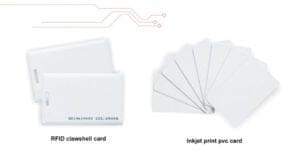


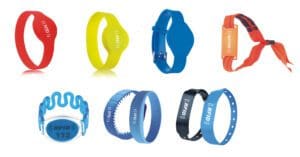


Let us know what kind of RFID Cards you need
At Colourfast we are committed to providing the highest level of service with every customer being assigned a dedicated account manager. Our team of experts are ready to help!
or
GET A QUOTE